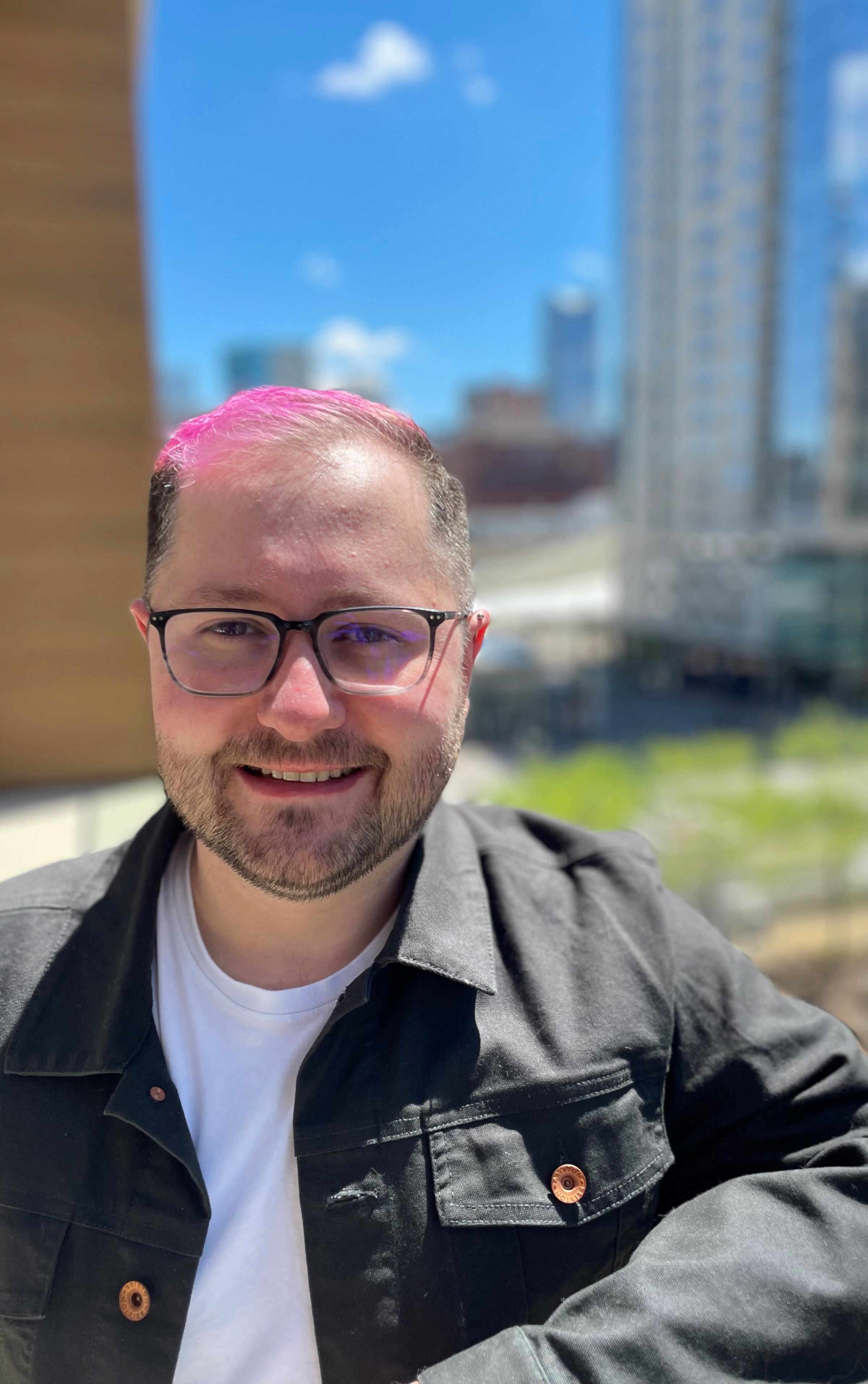
Dr. Kroll joined the UW Chemistry faculty in September 2024. With his first year as a Husky in the books, we took the opportunity to get to know him.
Early Life and Education
Alec grew up in the small town of Drummond, Montana. If you blink on your drive down I-90, you’ll miss the exit. During his summers he did yard work, worked construction with his father, and later worked with the janitorial staff at the local high school. It was in this small town that he learned the value and importance of community. At night, far away from city lights, he would lay out on the trampoline and stare up at the stars wondering how the universe worked. Alec ultimately left his small town and developed his chemistry research and teaching skills at Emory University and the University of Colorado Boulder. As a first-generation college student and the first in his family to earn a Ph.D., the move to Atlanta to pursue a bachelor’s degree in chemistry was a significant step.
From Big Sky Country to the Big Peach
At Emory, he began his research career in Professor Susanna L. Widicus Weaver’s group during the fall semester of his first year of college. He was surprised to walk into a brand-new research lab and see a mostly empty room with a wall of power tools. Dr. Widicus Weaver informed him that in her lab, he was more likely to use a wrench than beaker on most days. He quickly fell in love with physical chemistry and spent all four years of college working in the Widicus Weaver group. There, he studied the chemistry of star-forming regions to help us understand how chemistry changes and impacts the formation of stars and planets and perhaps even shed some light on the origin of life. His work included research in the chemistry lab at Emory as well as observational astronomy using the Caltech Submillimeter Observatory (CSO) telescope. Alec jokes that he is interested in answering “the easy little questions” like “Where did we come from? How did we get here? And where are we going?”
Research and Teaching: From Emory to Boulder and Back Again (and Again)
In 2012, Alec graduated from Emory and headed to graduate school at the University of Colorado, Boulder. There, in the group of Professor Veronica Vaida, he turned his questions a little bit closer to home, studying sulfur chemistry in the atmospheres of Venus and Earth. His graduate research project focused on understanding how sunlight can drive chemical reactions of sulfur dioxide and water resulting in the formation of aerosols. His interest in these questions was driven by a desire to understand the impact on the climate and habitability of planets as well as the impact on human health here at home.
While working as a graduate teaching assistant, Alec discovered that teaching sparked his passion for chemistry just as much as research did. “I found out that I loved working with students and seeing that lightbulb moment. Helping others to find their inspiration in chemistry inspired me,” he says. “As a gay man, I also had moments where I looked around and thought, ‘I’m not sure if this is the right place for me. Do people like me really do science? Do I fit in here?’ That feeling of imposter syndrome really started getting to me.” Fortunately, Alec’s mentors reassured him that the answer to those questions was an undeniable “Yes. You belong here.”
Motivated by those reflections and with the full support of his adviser, Dr. Vaida, he launched an education project to better understand how students in the general chemistry classroom see themselves. The goal of this project was to collect demographics data and understand who is in our classrooms, what they need, and how we can better guide them to success. The results of this study suggest that LGBTQ+ students are not underrepresented in the general chemistry classroom and a loss of these students from STEM is the result of a “leaky pipeline.” Our student body includes straight, LGB, queer, trans*, and non-binary students of all identities. Efforts to improve the experience of our classrooms will help all students to be better prepared to succeed. Alec is a strong believer in the philosophy that a rising tide lifts all boats.
After grad school, Alec had the unique experience of returning to Emory for a postdoctoral fellowship focused on chemical education and redeveloping the chemistry curriculum. Course design became more than professional development for Alec, it was a way to give back to his alma mater and help make it, as he puts it, “an even more amazing place to learn chemistry.”
When the fellowship concluded in 2019, an unexpected opportunity brought Alec back to Boulder to teach at CU. First as an adjunct instructor and then as a full-time assistant teaching professor. With his first year as an instructor including the spring of 2020 he found himself, “on a wild ride learning how to be a better professor.” During lockdown at the beginning of the pandemic, as an aerosol scientist, he saw his research field impacting the world in a way he never imagined. And as teacher, he also saw the impact of the loss of community and connection in the classroom. The resilience of his students during the pandemic inspired him to keep going through days that otherwise felt isolating and impossible.
At UW
When Alec saw that the UW was conducting a search for an assistant teaching professor in chemistry in autumn 2023, he applied, despite thinking it might be a stretch. He wasn’t sure that he was ready to leave Colorado (and its 300 days of sunshine a year) which he had considered home for almost 12 years now. However, halfway through the interview day, he found himself enthusiastically texting friends and family: “I want to work at UW. There is an excitement about teaching that reminds me of the feeling of the first time I stepped into a research lab.” While he had some apprehension about Seattle’s infamous rain, the chance to teach and work with “so many amazing people” made the decision easy.
Alec has now been at the UW for a year and has had the chance to teach the entire series of general chemistry courses. While he has taught many different chemistry classes in the last six years, this is the first time that he has taught a series of classes in order and gotten to usher an entire cohort of chemistry students through their introductory experience. Teaching three new classes in three quarters was a challenge. But with that challenge came the opportunity to truly integrate into the community and better understand the program. “I feel so fortunate to get to learn from all of my incredibly talented colleagues in the chemistry department and start to see how our program connects across the campus community.” His favorite part of teaching at the UW has been holding office hours in the study center and working one on one with students to help them understand the material. He says, “I’ve really loved getting to know the students and seeing them begin to move forward and succeed in their classes after general chemistry.” The excitement of working with so many first-year students and the regular coffee check-ins with faculty colleagues have made him feel welcomed in and made adjusting to the Seattle rain a little easier. Additionally, his mother is delighted to have Alec “just a short 8-hour drive down the road.”
Closing Reflections
As a first-generation college student from a town of 300 people, Alec followed an unexpected path. “My hometown was wealthy beyond measure when it came to community, love, and support. But one thing we didn’t have a lot of, was money,” he says. Thanks to scholarship support and financial aid, he was able to pursue the opportunities that led him to the UW.
While teaching professors are rarely the direct recipients of gift funds, Alec would like to express his gratitude to alumni and friends supporting the Department of Chemistry: “You make scholarships and awards for our incredible students possible. For that, I’ll always be grateful. And who knows? Maybe another future chemistry professor is sitting in this room thanks to your generosity.”
Although the UW awards more degrees in chemistry and biochemistry each year than the total population of Alec’s hometown, the UW Chemistry community shares something deeply familiar to him: a wealth of support, generosity, and connection. It’s a community Alec is proud to be part of—and one for which he is profoundly grateful.