We are pleased to announce that Assistant Teaching Professor Lutz Maibaum has been promoted to associate teaching professor, Assistant Professor Matthew Golder has been promoted to associate professor with tenure; and Associate Teaching Professor Larry Goldman has been promoted to teaching professor. These promotions are effective September 16, 2026.
Interviews were lightly edited for length and clarity.
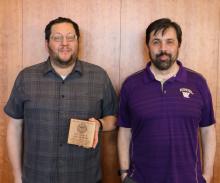
Lawrence M. Goldman
Teaching Professor
- Give a high-level description of your teaching focus.
I teach primarily organic lecture and lab classes. My goal in my lectures is to implement more active learning so students have a chance to talk with each other rather than passively listening for an hour. I’ve also implemented opportunities for students to show growth such as second-chance exams (not easy in a 300-person class!). In the organic labs, I’ve worked to include more critical thinking experiments rather than “cookbook” activities and implemented computational chemistry via WebMO since that’s not something many students see elsewhere. [WebMO is a web-based interface students can use to perform advanced computational chemistry.] - What would you like to highlight about your recent achievements?
This spring, Eric Camp and I were awarded a Husky Sustainability Award for green innovations we’ve brought into the organic teaching labs. These include removing methylene chloride from the teaching lab in advance of EPA restrictions, replacing the water-sensitive magnesium in a Grignard reaction with water-tolerating zinc, and a solvent-free Friedel-Crafts acylation reaction. Outside of the university, last fall I was re-elected to a second term on the Lake Forest Park City Council. - What do you hope will be standard in chemistry instruction in higher ed 20 years from now?
I’d like to see widespread implementation of active learning in large classes, second-chance exams and other methods that allow students to show mastery of the material. - What advice would you give to yourself when you were hired at UW?
First, don’t be afraid to try innovations. When I first started, I was concerned about trying new teaching strategies for fear that they wouldn’t be successful, or my teaching evaluations would suffer. But over time, I’ve seen that the chemistry department encourages us to try out interesting ways to approach our classes. Second, be willing to allow students to see me as a person. When I started, I tried to teach as “clinically” as possible. I’ve learned that when students see their instructor as a whole person rather than just “the teacher,” it leads them to perform better. So more recently, I’ve been open with my students about topics such as being an elected official, having autism, and being openly gay. - How does being a chemist and educator inform your service as a city councilmember?
Chemistry occasionally shows up in city council. For example, some local community college students presented about 6-PPD-quinone’s negative impacts on the environment, particularly salmon health. Since 6-PPD-quinone is found in tire residue, government policy on vehicles, speed limits, and road design can have an impact. Being a teacher has helped me distill complex topics into a cohesive city policy when developing city legislation that can be readily understood by the public. But most importantly, I think it’s important to show that anyone can be involved in local government. You don’t need to be in a “traditional” career to represent the community as an elected official.
To learn more about Professor Goldman and his work, please visit his faculty page and the Chemistry Education Group page.
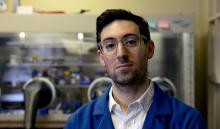
Matthew R. Golder
Associate Professor
- Give a high-level description of your research focus.
My group thinks about how plastic materials are constructed at the molecular level and works to tune atomistic composition to optimize performance and/or recyclability. We try to balance the prevalence of plastics in the modern world with the concurrent need to mitigate waste, all while considering feasibility to translate to real world problems. - What would you like to highlight about your recent achievements?
The group has recently been recognized with a Sloan Research Fellowship and a Camille Dreyfus Teacher-Scholar award. Our recent work in ACS Central Science was featured on the front cover of the June 2026 issue.
Recent graduates from the group have been recognized with honors as well, including Dr. P. Brian Sun (Larry R. Dalton Prize for Best Dissertation in Materials Chemistry, now a postdoctoral researcher at Harvard University with Prof. Jarad Mason), Dr. Morgan Skala (Hyp J. Dauben Prize for Best Dissertation in Organic Chemistry, now a postdoctoral researcher at Washington University in St. Louis with Prof. Christopher Cooper), and Kieran Lyons (Distinguished Research in Chemistry Award, beginning as a chemistry Ph.D. student at the University of Illinois Chicago in fall 2026). - What do you hope the legacy of your research group will be?
I hope that commercial materials apply our "basic science" findings to improve performance or end-of-life fate in consumer/industrial products. And of course, I hope I can continue working with students who have better ideas than me!
To learn more about Professor Golder and his work, read "A Second Life for Plastics," recently published by the College of Arts & Sciences. You may also visit his faculty page and research group website.
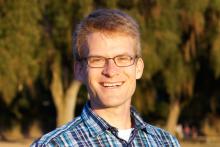
Lutz Maibaum
Associate Teaching Professor
- Give a high-level description of your teaching focus and the unique perspective you bring to teaching.
I often teach large introductory courses that are taken by students with a wide range of backgrounds, levels of preparation, interests, and needs. What they have in common is their great potential to learn, and I need to help them realize that potential. Students learn most effectively when they enjoy the process and care about the material, and I strive to make my courses relevant and accessible to them. - What would you like to highlight about your recent achievements?
I recently had the opportunity to collaborate with colleagues across the university to evaluate and improve the accessibility of our courses for students with disabilities. Learning about the diverse needs of our students and the importance of addressing those needs in the classroom was an eye-opening experience. It was inspiring to see how deeply many faculty members care about making sure that education is truly accessible for all. - What do you hope chemistry instruction in higher ed will look like in 20 years?
I hope that we will continue to provide rigorous and relevant education that is accessible to anyone who wants to study chemistry. I believe that new technologies such as AI will become common elements of how students learn. At the same time, they cannot be a substitute for the personal connections between students and instructors and among students themselves, which I find essential for successful and enjoyable learning. - What advice would you give to your less experienced self when you first started teaching gen chem?
Teaching, like learning, works best if it is done with joy and enthusiasm. If I could send a message to my younger self, I would encourage myself to go into the classroom to have some fun. Chemistry is a serious and difficult subject, but both students and instructors should enjoy the process of discovering it together.
To learn more about Professor Maibaum and his work, please visit his faculty page and the Chemistry Education Group page.
Thanks to Cecily Rosenbaum, Ph.C., for contributing this story to our news page.