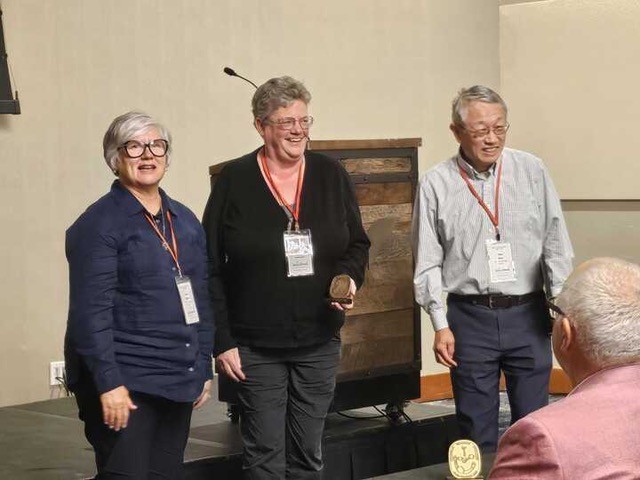
Earlier this month, the Conference on the Dynamics of Molecular Collisions presented the Herschbach Medal to Professor Anne McCoy at their twenty-ninth meeting held in Snowbird, Utah, July 6-11, 2025.
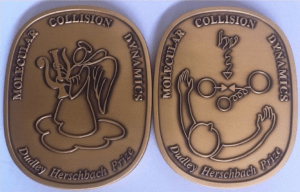
Outstanding theoretical and experimental contributions to the field of chemical dynamics are recognized at the biennial conference by awarding the Herschbach Medal, named in honor of Dudley Herschbach, a pioneer in the field of reaction dynamics, who won the Nobel Prize in Chemistry in 1986. The associated medal was designed by Herschbach, and in his words it is intended to recognize “bold and architectural work, inspiring and empowering. Such work addresses fundamental, challenging, frontier questions; brings forth new perspectives and capabilities; and typically excites evangelical fervor that recruits many followers.”
McCoy expressed her appreciation for the recognition, noting, “It is something I am very pleased about, as I was selected by colleagues in the reaction dynamics community,”—experts in the field who determine the recipient without an open call for nominations.
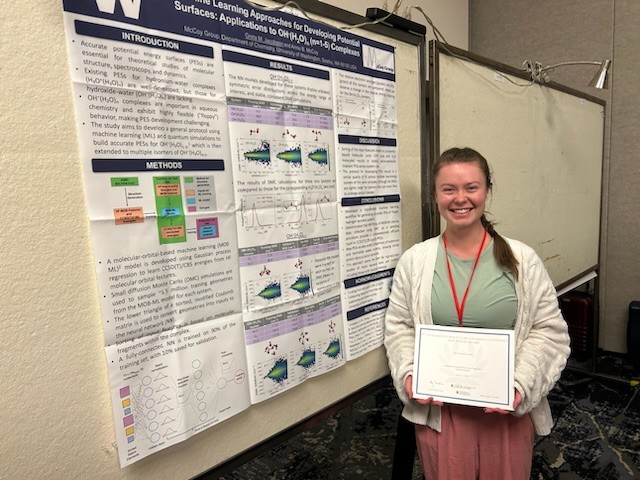
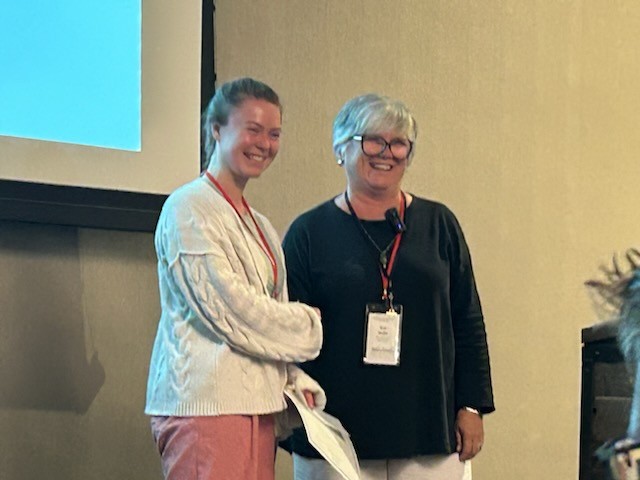
Additionally, Greta Jacobson, a Ph.D. student supervised by McCoy, received a poster prize at the conference for her presentation of “Machine Learning Approaches for Developing Potential Surfaces: Applications to OH-(H2O)n (n=1-4) Complexes.”
It has been an eventful few months for the McCoy group, as McCoy presented the Journal of Molecular Spectroscopy Special Review Lecture at the end of June (see our instagram post) and was elected to the American Academy of Arts and Sciences earlier this spring.
McCoy’s research focuses on the development of theoretical and computational approaches that allows her to investigate molecules and complexes that undergo large amplitude vibrational motions even at low levels of excitation. These processes are important in a variety of contexts, including systems of interest in astrochemistry, atmospheric chemistry, and in combustion processes. McCoy’s theoretical and computational tools also allow her and others to probe more fundamental phenomena, such as hydrogen bonding or long-range charge transfer for which standard tools are insufficient, making them particularly interesting from a theoretical perspective. In choosing problems to study, the McCoy group focuses on systems that have been studied or are currently being studied by their experimental collaborators or are potential targets for future experimental investigation.
The Conference on the Dynamics of Molecular Collisions provides an opportunity for experimentalists and theoreticians in the field of chemical dynamics to gather over five days to discuss the latest developments in areas such as bimolecular collisional dynamics, dynamics in the condensed phase, photodissociation dynamics, reactions at interfaces, nonadiabatic dynamics, quantum control and cold reactions, and applications to combustion, atmospheric, and interstellar chemistry.
To learn more about Prof. McCoy and her research, please visit her faculty page and research group website.
To learn more about the Herschbach medal and the history of the Dynamics of Molecular Collisions Conference, please visit the conference website.