Story by MEM-C Staff
If this newsletter had a “help wanted” section, it would include a listing: MEM-C needs undergraduate researchers. UW MEM-C (Molecular Engineering Materials Center) is an NSF-funded Materials Research and Engineering Center (MRSEC). For MEM-C’s Director, Prof. Daniel Gamelin, the task of getting undergrads involved in research is personal. “I was incredibly lucky to have the opportunity to participate in an NSF-sponsored research experience when I was an undergrad, and that chance early on in my academic career—operating instrumentation, collaborating with other scientists on a long-term research project, and actively exploring new phenomena—got me positively hooked on research and showed me just how cool it is to have the opportunity to do science in an academic institution.”
Why does MEM-C need undergraduate researchers?
Prof. Andrea Carroll, MEM-C’s education director, knows all too well how crucial the four years of undergrad are to developing both scientific curiosity and confidence. As she says, “MEM-C is a small community within the very large UW research ecosystem. We know that every step of the science journey is a milestone to be celebrated, and we know that caring for the connections between researchers at each one of those stages is critical to both developing professional scientists and creating a community where scientific advancements can flourish. Undergraduate research opportunities bring a spark of creativity not just to the undergraduate students but also to the faculty members who host them, the graduate students who mentor them, and the broader communities in which the students live and learn.”
Eden Tzanetopoulos (PhD student, Chemistry) served as a mentor for undergrad researcher Alice Leppert (Junior, Chemistry) in the Gamelin lab for the past year. For Eden, the combination of doing her own thesis research and designing a project for Alice was a fulfilling experience. She explains why working with mentees is so rewarding, “Working with Alice initially made me confront how insular grad school can be. I realized that, before working with an undergrad, every ‘nearest neighbor’ I had was a fellow graduate student. I found it really rewarding to get to know someone earlier in their academic career, and it allowed me to work on explaining concepts so we can all get to a level of real understanding. Also, something that I really appreciate from Alice is that not only is she energized and interested in research, but she is also interested in the ‘why’ in a very deep way. I find that rewarding as a mentor because it makes me remember that there’s a lot to be gained by being motivated by the ‘why’ and it makes me a better scientist.”
MEM-C undergrads and their mentors share the research journey
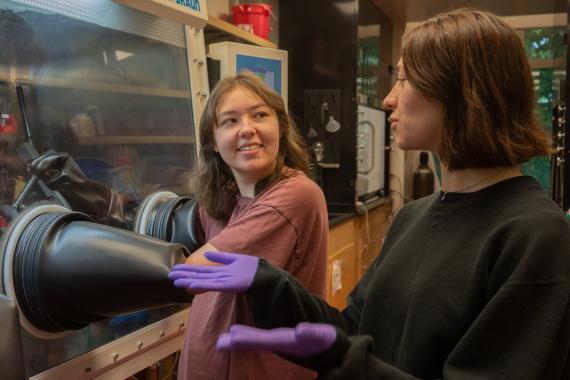
Eden and Alice both agree that there was a particular moment this summer when Alice stepped up into a more independent phase of research. Together, they had been chipping away at synthesis approaches for chromium-based semiconductor nanocrystal spinels, such as Zn(Cr1-xInx)2S4. They were doing lots of trial-and-error work and going over the fundamentals of synthesis, like why a certain solvent is used and which ligands are best. Eventually, on her own volition, Alice dug into a literature review and, as she describes, “I spent hours looking up keywords and going citation by citation,” or in other words, “going down a citation rabbit hole” as Eden laughingly called it.
But the search wasn’t in vain! Eden remembers Alice confidently approaching her with the results of her literature review. “Alice came up to me and said, I found these three papers, and I want to try this synthesis. She knew what temperature she wanted to try, which solvents, and I was like, ‘yeah, get in there and go do it!’ It was a great culmination of the summer, seeing Alice have that autonomy.” And as Alice remembers it, “I did feel really great! I understood enough about what I was doing and why I’m doing it that I can be like “hmm, this didn’t work, what can I do next?”
Alice is now expanding into a new MEM-C project with the Gamelin group this academic year with a new mentor, Nicolas (Nick) Nguyen (PhD student, Chemistry), where together they’ll work with other MEM-C researchers on experimental and computational studies of aluminum-alloyed chromium thiophosphate (Al1-xCrxPS4) to understand phase changes that occur with increasing aluminum. As a mentor, Nick finds himself working with Alice in ways that resemble how his own mentors have supported him, he says, “My personality aligns with how my adviser randomly pops in and asks, ‘Hey how are you doing? What’s going on here?’ And I feel like I’ve done that to Alice a bunch of times, asking, ‘Hey, how’s it going? What are you working on?’” (Nick and Alice laughed in agreement on this.) Nick remembers his time doing undergraduate research at the University of Oregon where he didn’t have a graduate student mentor, and so he says, “My PI was my mentor and something that I really appreciated was that during critical points in the school year she would ask, ‘Is this too much? Are you getting too busy? You don’t have to strain yourself when things are getting busy,’ and that always made me feel like I was enough and that I never had to overexert myself. I try to mimic that with Alice and let her know if life gets busy or she has classes or needs to do something, that it is okay to take care of other things outside that aren’t research.”
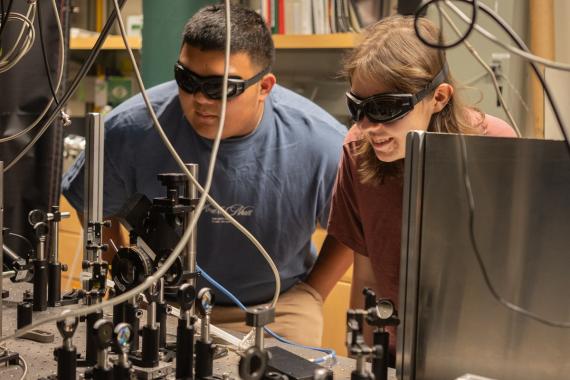
And Alice does have other activities outside of research! She’s a violinist in UW's Symphony Orchestra, and she loves hiking and watching movies with her friends. But even with the other parts of life, she is “so excited to start this new research journey with Nick,” as she goes on to explain, “I've been learning a lot about magnetism recently and how the structure of a material and temperature heavily influence the magnetic character you see. It's crazy to me how everything is magnetic and has magnetism, yet it manifests differently in each material. Seeing how it fits in with how magnetism has been taught in my chemistry and physics classes has been really cool as well!”
MEM-C’s long-standing commitment to getting undergraduates into the laboratory
MEM-C is not alone in recognizing the importance of undergraduate research opportunities. In 2017, the National Academies of Science issued an influential report about the state of undergraduate research in the U.S., and more recently, the UW Office of Undergraduate Research has launched the Research Collective. In MEM-C’s eight-year history, the Center has created opportunities for more than 90 undergraduates to do materials science research in laboratories across UW Seattle’s campus, and the Center is expecting a new cohort to start this fall for its Academic Year Research Accelerator (AYRA) program. By this coming January, MEM-C will open applications for its competitive summer 2026 Research Experience for Undergraduates (REU) program.
As Prof. Xiaosong Li, MEM-C co-PI, explains, “When MEM-C received our initial MRSEC award from the NSF in September 2017, we launched our first undergraduate research program that same fall quarter and the strength of the Center’s programming around undergrads has evolved and blossomed over these past 8 years and will continue to do amazing things. All of us in MEM-C, especially those of us who are faculty and have succeeded in scientific research, know without a doubt how important it is to get students engaged in hands-on laboratory work and real problem solving as soon as possible to expose them to the fun, skill, and pace of cutting-edge discoveries that happen here at UW.”
Undergraduate research with MEM-C means collaboration
As one of only twenty MRSECs nationwide, MEM-C runs one of the few NSF-funded REU programs on the UW Seattle campus (see the UW Office of Undergraduate Research’s full list of undergraduate programs). Beyond the formal AYRA and REU participant programs, MEM-C funding supports more than 20 UW faculty engaged in materials science research across the Seattle campus, and many of these MEM-C groups host undergraduate researchers throughout the year. Moreover, MEM-C is engaged in two NSF-funded Partnerships for Research and Education in Materials (see the department’s 2024 newsletter story for more about these PREMs), a key part of which is hosting undergraduates from the University of Hawai’i and University of Central Florida to study with MEM-C researchers over the summer.
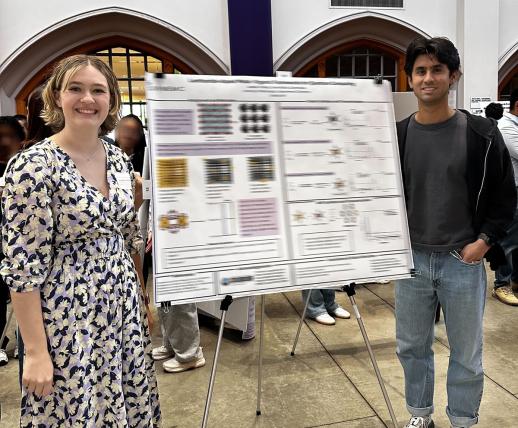
This deeply collaborative structure of MEM-C makes for a special undergraduate research experience, as Prof. Dianne Xiao emphasized, “the opportunity to interact with multiple research groups within MEM-C is a benefit for all participating researchers, including the undergraduates.” Izzy O’Reilly (Junior, Chemistry/Psychology) synthesized lanthanide doped metal organic frameworks (MOFs) in the Xiao lab over the summer with their graduate student mentor Devin Rollins (PhD student, Chemistry), and as Prof. Xiao explains, “these materials are not only of interest to our group but have the potential to be studied further in Brandi Cossairt’s lab where Izzy will be doing research in the upcoming academic year.” Prof. Cossairt agrees, “MEM-C brings students into a dynamic and interdisciplinary collaborative environment that makes them feel like part of a larger research community. It helps them see how their research project fits within a broader scientific effort.”
As Izzy describes it, synthesizing MOFs involved an aspect of lab work, vacuum filtration, that was intimidating at first but that she eventually really enjoyed and became confident doing. She explains, “In my general chemistry lab class, I once imploded a waste beaker because I hooked up the vacuum filter system wrong, and it was perhaps the most humbling experience I’ve ever had. So, when I learned that a lot of what I was going to be doing in the Xiao lab was filtering off precipitate, I was more than a little panicked. Let it be known though, that not only did I not break any glassware during my time in the MEM-C REU, but that I came to find vac filtering very meditative!” And, her mentor Devin agrees, “Izzy was an incredibly adaptive and quick learner! She came into the Xiao lab with no previous synthesis experience and left as an expert on synthesizing clusters. She helped shape the story and establish important progress on a new MEM-C project.”
Both Prof. Xiao and Devin see the mutual benefit of the mentor-mentee relationship that MEM-C undergraduate research brings. As Devin recounts, “What surprised me about the mentoring experience is how many questions I didn’t know the answer to. Mentoring has been a big learning experience for me, too, and I often had to revisit certain topics and techniques before I could explain them. Izzy tends to ask curious questions that don’t have obvious answers. I was surprised at how much better an understanding I had of the project after explaining what I had thought were simple and subtle details, but are actually important fundamentals. I would absolutely encourage other MEM-C graduate students to mentor an undergraduate researcher. The experience is incredibly rewarding and will help you to become a better researcher and teacher.”
Prof. Xiao and Prof. Cossairt agree that mentoring has many benefits. As Prof. Xiao explains, “The graduate student mentors definitely learn a lot by working with undergraduates. From a mentorship perspective, graduate students learn how to strike a balance between giving sufficient guidance but not micromanaging. They also learn how to juggle multiple projects and responsibilities. It's a lot of work, but very valuable and rewarding.” Prof. Cossairt adds, “PhD students who work with undergraduates really improve their ability to frame and motivate their own work. It also helps with time management and chunking work into smaller tasks that are achievable and lead to forward progress.”
Izzy is finishing out the summer on a trip with a friend that she met in the MEM-C summer REU program and is excited to get back to work on quantum dots in the Cossairt lab. She has this advice for anyone considering undergraduate research: “Say yes to anything and everything that interests you. Had I not taken the Chemistry Frontiers course just because I saw a flyer on it, I would not have started doing chemistry research at UW, and I most certainly would not have applied to the MEM-C REU program. In that same vein, I would also say be open and curious, ask the 'stupid' questions, and be ready to fail about a million times, it will all be worth it in the end!” This excitement is just what MEM-C likes to see in its undergraduate researchers. As Prof. Cossairt sums it up best, as for what type of prior experience is needed from undergraduate students, she says, “My primary expectations for undergraduates are unbridled enthusiasm and a willingness to commit and engage. Everything else can come from what they can learn during the research experience and working with their mentor.”
As Gamelin states, "engaging undergraduates in research at UW will always be a priority for MEM-C. Educational studies have demonstrated that early exposure of undergraduates to laboratory research increases retention and graduation rates and instills a lifelong appreciation of science. It is one of the most rewarding experiences for everyone involved."
Undergraduate students interested in research opportunities with MEM-C can visit MEM-C Undergraduate Offerings for program details.
For additional opportunities, visit the Department of Chemistry’s Undergraduate Research page, meet with an undergraduate adviser, visit the UW Office of Undergraduate Research, or reach out to Free Radicals, the undergraduate student club for chemistry and biochemistry majors.